




_thumbnail.jpg)
_thumbnail.jpg)



Abstract
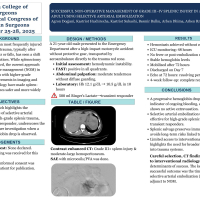
Introduction: The most frequent solid organ injury in blunt abdominal trauma (BAT) is splenic injury, and it is typically a result of road traffic accidents or falls. While operative management was the standard practice, the trend today is increasingly towards non-operative management (NOM), including in hemodynamically stable patients with even moderate-to-high-grade injuries [1,2]. This shift has been facilitated by advances in interventional radiology and imaging, which have played a pivotal role in expanding the indications for NOM and keeping medical personnel familiarized and up to date [3].
Case presentation: Here, we report a case of a 21-year-old male with Grade III+ splenic injury with moderate-to-large hemoperitoneum following a road traffic accident on a motorcycle. After initial resuscitation, the patient remained a transient responder. CT with IV contrast showed no indication of ongoing bleeding. With progressive hemoglobin drop in the background, the patient was successfully treated with selective splenic artery embolization at a private institution, reaffirming the efficacy of the intervention. The patient recovered completely without any requirement for surgery and was discharged on the seventh day.
Conclusion: Selective splenic embolization may be an effective and safe adjuvant to NOM in high-grade splenic injuries with transient responders, reducing the need for splenectomy and preserving immunologic function.
Keywords: Blunt abdominal trauma; Splenic injury; non-operative management; Embolization; Interventional radiology
Successful Non-Operative Management of Grade III-IV Splenic Injury in a Young Adult Using Selective Arterial Embolization: A Case Report
- Agron
- presentation-in-congresses-conferences-seminars
- Hits: 624

User Rating: 5 / 5

